





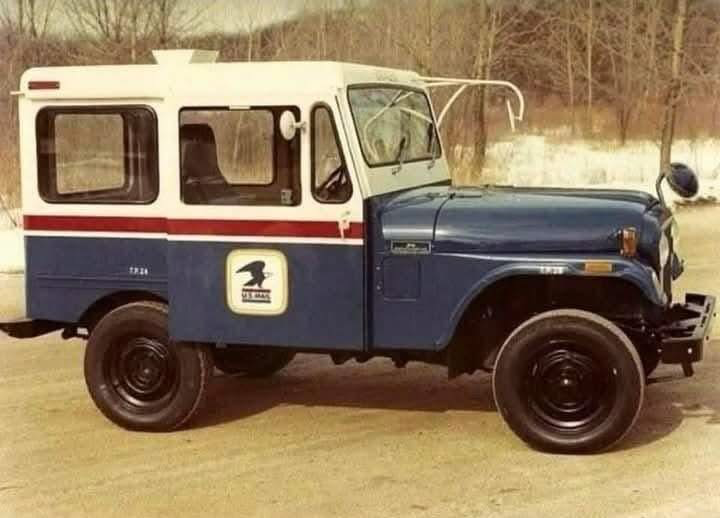
How a Wartime Legend Became a Postal Workhorse
When you think of Jeep, chances are your mind goes straight to muddy trails, rugged mountains, or heroic scenes from World War II. And rightly so—Jeep has long been a symbol of American resilience, earning its stripes on the battlefield as a vehicle that could go anywhere and do just about anything.
But there’s another side to Jeep’s legacy that’s rarely told. A quieter, humbler chapter—one that begins not on the front lines, but on neighborhood streets and rural backroads. This is the story of the Dispatcher Jeep, the unsung hero that helped keep America connected—one mailbox at a time.
From Battlefield to Backroad
In the years following World War II, Willys-Overland—the company behind the original military Jeeps—shifted its focus from war to work. Their first civilian offering, known as the CJ (short for Civilian Jeep), was pitched to farmers and ranchers as a sort of mechanical mule—a tractor in disguise, ready for daily labor.
But Willys had bigger ideas.
They saw the Jeep’s potential not just as a tool, but as a utility vehicle for all sorts of everyday jobs—including delivering mail.
Enter: The Dispatcher Jeep
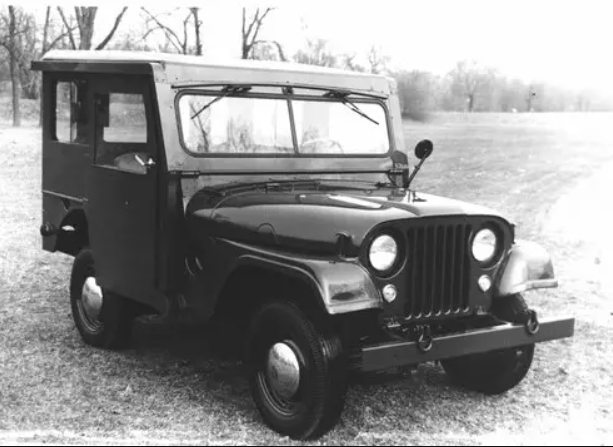
To make that vision a reality, Willys simplified the already-spartan CJ design. They removed the four-wheel drive system, swapped in a column-shift transmission, and added fully enclosed body options—including a panel van configuration. The folding windshield? Gone. What remained was a stripped-down, purpose-built machine: the Dispatcher Jeep, or DJ for short.
The first model, the DJ-3A, was based on the CJ-3A. And just like its military predecessor, the DJ was tough, dependable, and unbothered by rough terrain or bad weather. It was exactly what the U.S. Postal Service needed.
Built for the Route
The DJ line quickly proved itself on America’s mail routes. It was sturdy enough for unpaved roads and snowy driveways, yet simple enough to maintain. As the line evolved, new versions like the DJ-5 and DJ-6 were introduced, and even a batch of Scrambler models were custom-built for Alaska’s demanding conditions.
Many of these mail Jeeps came with right-hand drive, making it easier for postal workers to reach roadside mailboxes without leaving the driver’s seat—a clever adaptation that became a signature feature.
Later DJs received more upgrades tailored for mail delivery, including large sliding doors, wide mirrors, and extra lighting fixtures. One of the more noticeable changes was the introduction of a distinctive “bump-out” grille to accommodate AMC’s inline-six engines. Meanwhile, CJ models kept their classic look and simply extended the frame and fenders to fit the larger powerplant.
A Different Kind of Hero
The Dispatcher Jeep didn’t win wars or scale mountains. It didn’t make headlines or star in action movies. But for decades, it was a quiet champion of American life—faithfully delivering letters, checks, birthday cards, and holiday packages through rain, snow, and summer heat.
While the original military Jeep captured glory, the DJ earned something just as meaningful: trust.
It’s a reminder that not all heroes roar onto the scene. Some simply show up—day after day, with the mail in tow.
Connect with us


